
REX FOR EMERGENCY RESPONSE
You have minutes.
The search takes five seconds.
REX for Emergency Response is one system for handling a life-critical location request from Search and Rescue. Your NOC searches one system, logs the request, and sends the answer over API into the map of a rescue crew who are already in the air, so they can narrow the terrain instead of flying over it.
5 seconds
A typical search for one person, under normal conditions
2 integrations
Your MLC and your cell inventory. CRM if you have it.
1 system
Request, search, delivery and audit log in one place
RIGHT NOW, A POSITION IS ASSEMBLED BY HAND
Why locating a missing person takes hours today
The request comes at 03:00, and in most networks the answer is still built by hand; searches across several systems, run by whoever can be reached, read out over the phone.
WHAT IT LOOKS LIKE TODAY
WHAT IT COSTS
No single system. A position assembled from several network systems by hand.
Hours, where seconds decide.
Person dependency. A few named individuals can produce the answer.
If they are unreachable, the capability is not there.
Manual handover. The position passed by phone, mail or voice.
Transcription errors, in the one step that has to be exact.
Staffing. Effective coverage means specialists available 24/7.
FTE cost for a capability used sporadically.
No audit trail. Little logging of what was requested, by whom, on what grounds.
The legal review has nothing to review.
Being the missing link. The rescue service cannot use its capability because of you.
Reputational and political exposure.
Hours by hand. About five seconds in one system. Every hour of that difference is a crew flying over ground they cannot narrow.
ONE CHAIN, FROM EMERGENCY CALL TO THE CREW IN THE AIR
How a Search and Rescue location request works

01
The aircraft launches
Search and Rescue takes the call, gets an indication of direction, and is in the air on it. It does not wait for the network detailed answer.

02
One search, in one system
Your NOC searches only in REX and gets the last known cell location and direction, with Timing Advance precision from your MLC. The authority, the stated grounds and the case reference are logged before the search runs. Search result in about five seconds.
03
It reaches the crew mid-flight
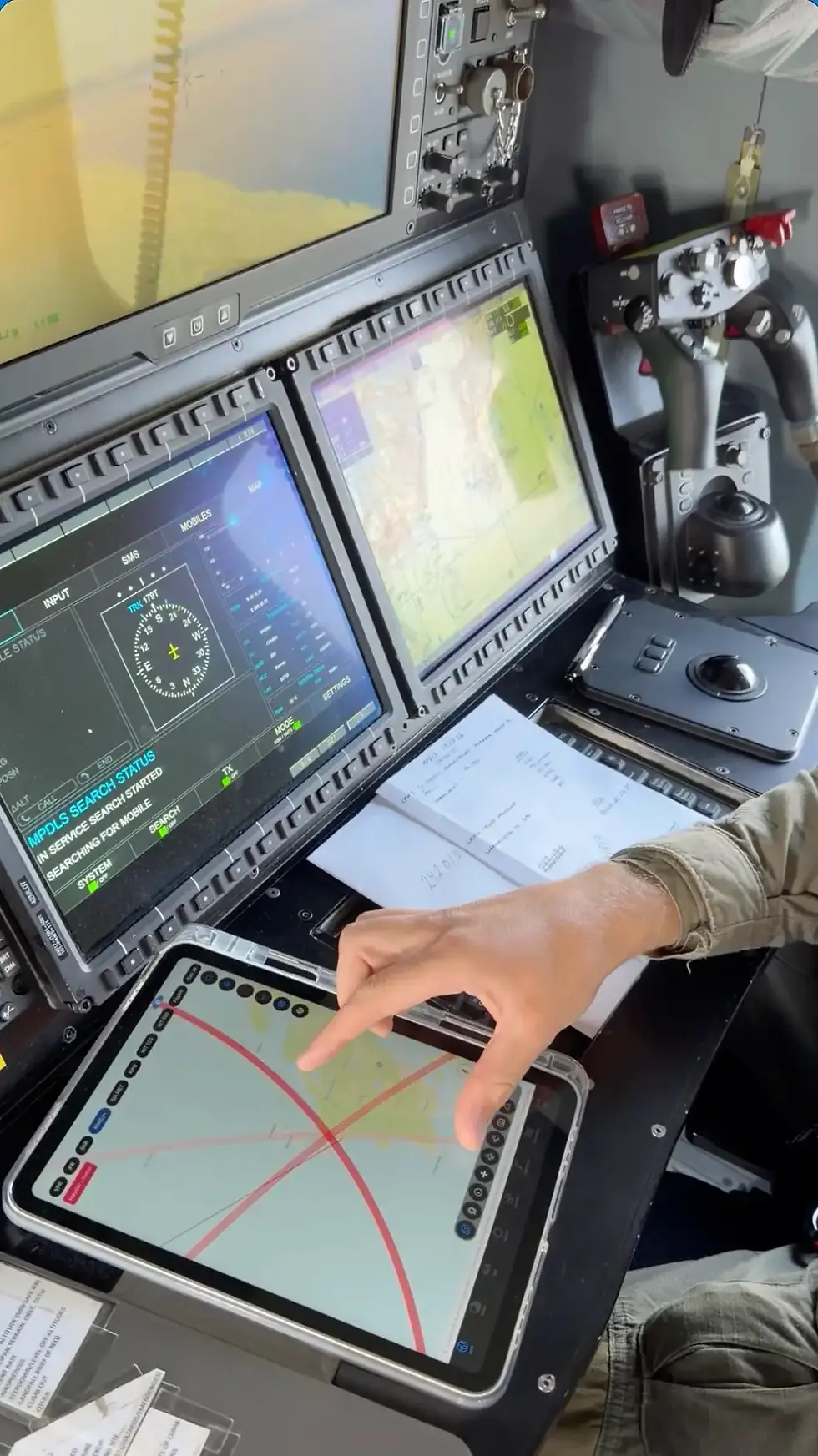
Sent to the helicopter over an API built for rescue services, into the crew's own map system, in real time.

04
The search narrows
The crew triangulates around the area they have been given. The mobile base station (MPDLS) and IMSI catcher on board connects to the handset, and Timing Advance data turns the sweep into hundreds of positioning points and worked together with the aircraft's maps, and its other equipment to accurate position of the mobile device and the lost person.
By the time your search starts, the crew is already airborne. Nothing they carry can narrow the terrain until your answer reaches them. That is what the five seconds are for.
What REX for Emergency Response does
One search, one system, one answer
Your NOC searches REX, not four network systems in turn. The case record, the log and the exchange with the authority sit in the same place. The answer looks the same every time, whoever is on shift.
Timing Advance that keeps working mid-flight
The crew is already airborne when your search starts. REX keeps the Timing Advance positioning accurate for them throughout, which is what turns their sweep into hundreds of positioning points instead of a search area. MPDLS cannot supply this half for itself.

TWO INTEGRATIONS TO START
What data sources REX for Emergency Response needs
MLC
Your Mobile Location Centre, which also supplies real-time Timing Advance. This is what turns a cell into a position.
Cell inventory
Your cell and cell direction data. It is what lets REX return not just the last known cell but the direction from it – the difference between sending a crew to a circle and sending them to a sector.
CRM
If subscriber data is available, REX correlates it. If it is not, the workflow runs without it.
No long development projects. This is a system your NOC can be running this season.
EXTERNAL ACCESS, ON YOUR TERMS
How rescue teams get secure, temporary access
Rescue personnel do not get an account. They get a token, issued for one operation.
Scoped to the case — they see what the operation requires, nothing else.
Time-limited — access expires with the operation, not with someone remembering.
Revocable — at any moment from your side, immediately.
Fully logged — every action by every external user, on the same record.
Field-ready — it keeps working while the crew is on the ground.
External access is scoped, temporary, revoked and logged.
THE AUTHORITY MAKES THE ASSESSMENT
The legal basis for disclosing location data in an emergency
Emergency and vital-interest provisions permit disclosure that would otherwise not be permitted. The police and rescue services make that assessment and may have it reviewed afterwards and the operator acts on the request it receives. REX keeps the record that the review needs.
REX for Emergency Response holds no history — it answers from activation forward. The Historical Timing Advance add-on works on a bounded window set with your legal team e.g., 24-48 hours.
ON EVERY REQUEST, REX LOGS
-
The requesting authority and case reference
-
The stated legal grounds
-
Who ran the search, and when
-
What was searched and what was returned
-
What was disclosed, to whom, in what format
-
Every action taken under third-party access
REX answers where the handset is now. The case it cannot answer alone is the one that starts too late: the battery died before anyone raised the alarm. That case needs history.
Real-time Timing Advance
Included from the start, via your MLC. Answers where the handset is now.
Historical Timing Advance
The add-on. Answers where the handset was before it went silent.
WHEN THE PHONE WAS ALREADY OFF
Historical Timing Advance — finding a handset that has gone silent
The two are complementary: historical TA is not searchable for roughly its first 30 minutes, which is exactly the window real-time covers. Start with the first; add the second when the case that begins with a dead battery becomes the one you cannot afford to lose.

FOR RESCUE COORDINATORS AND AUTHORITIES
Why MPDLS depends on the mobile network
An MPDLS is a mobile base station carried on a drone or a rescue helicopter. The crew launches on a first indication of direction and is over the terrain within minutes, that part waits for nobody.
Narrowing the search is what waits. The operator supplies the last known cell and the direction from it, over an API built for rescue services. Only then can the crew triangulate around that area, connect to the handset from the air and let Timing Advance data turn the sweep into hundreds of positioning points — a position rather than a region, worked together with the aircraft's maps and thermal cameras.
It is a large part of why a search that took hours or days across big terrain can close in hours. Without the accurate telecom network data, the aircraft is up there with nothing to narrow by. That is how a country can buy MPDLS and still not have the capability.

From Emergency Response to the full REX platform
Questions your team will ask
Your MLC gives you a location and real-time Timing Advance. REX is the operational layer around it, not a replacement for it.
What the MLC does not give you is everything that turns a location into a rescue: request handling, a case record, a log, the same delivery format every time, secure access for the rescue crew, and the API into the helicopter's map.
And it is REX that keeps that Timing Advance working for a crew already in the air — hundreds of positioning points from above, not one more precise cell.
And it is REX that keeps that Timing Advance working for a crew already in the air — hundreds of positioning points from above, not one more precise cell.
A search for one person, under normal conditions, typically returns in about five seconds. That is the search itself — the request is already logged, and the position goes on to the rescue crew's map over the API from there. Historical searches and unusual network conditions take longer.
Your MLC and your cell inventory. CRM data if you have it available, the workflow runs without it picking up subscriber data via MLC.
The legal assessment is made by the police and rescue services under emergency provisions, and it is reviewed afterwards. The operator acts on the request it receives. What REX adds is the record showing exactly what was requested, on what stated grounds, and what was disclosed. That record is what protects the operator.
REX for Emergency Response keeps no history at all, it answers from activation forward. The Historical Timing Advance add-on works on a bounded window, set with your legal team, for example 24-48 hours.
Access is temporary, scoped to the case, revocable and logged. It is issued as a token for a specific operation, not as an account. There is no standing access and nothing to remember to remove.
Volume is the wrong frame. This is readiness, like any other emergency capability. And the comparison is not against zero, it is against maintaining specialist availability for a workflow that today runs on a few named people.
The authorities own the aircraft, the crew and the mobile base station on board. The telecom operator owns only data that tells the equipment where to work.
If the airborne investment has already been made by authorities; the telecom operator side is what turns it into a capability. In Norway that is exactly how it works, and it is why the operators there are part of the rescue chain rather than a request queue.
The mechanism is the same wherever an operator can lawfully disclose location data to a coordinated rescue effort. What differs is who coordinates; civil rescue service, police or military and the legal route.
There are limits on parallel searches and they depend on your MLC vendor. The REX Platform can run multiple searches in parallell.
Yes. REX supplies the area and the Timing Advance the airborne base station works from, over an API built for rescue services.

The next call will come. The crew will already be in the air.
Five seconds to a position, two integrations to start.